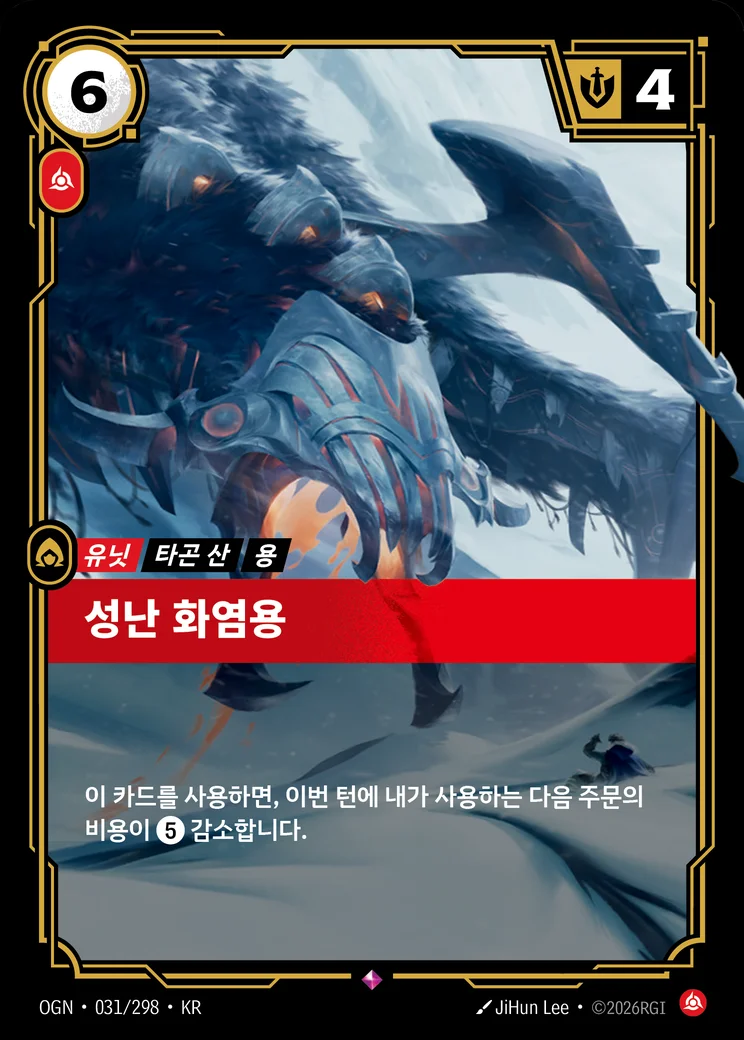
유닛
성난 화염용
에너지
규칙
이 카드를 사용하면, 이번 턴에 내가 사용하는 다음 주문의 비용이 감소합니다.
카드 정보
- 세트
- Origins OGN
- 카드 번호
- OGN-031/298
- 희귀도
- 희귀
- 유형
- 유닛
- 태그
- Dragon, Mount Targon
- 힘
- 1
- 아티스트
- JiHun Lee
다른 언어 이름
사용 가능 여부
시뮬레이터 지원
완전 구현
인쇄된 모든 스킬이 시뮬레이터에서 작동합니다.
판정 및 정오표
›Legion
Legion’s change in this rules update is a byproduct of the transition that Riftbound finds itself in. To pull back the curtain, our hope in the future is to reduce the confusion around “play” meaning different things in templating. Unfortunately, this rules update has pulled us in three directions and made things temporarily more confusing. We will communicate these rules in a more comprehensible way in the next rules update. That being said, we recognize that these three technical meanings of play are quite frustrating for players and we’re in the process of paring them down.
For this rules update, we’ll address three functional meanings of “play”, though two of them are aligned in a way that should make them feel like they are functionally similar.
The first meaning is, “resolve an item on the chain.” This is the play that appears in trigger conditions, in cards like Darius, Trifarian and Ravenbloom Student.
The second meaning is, “finalize an item on the chain.” This is the play that appears in other conditional statements and effects that check if cards have been played, in cards like Battering Ram, Crescent Guardian, and the Legion dependent keyword.
The final meaning of play is, “place an item on the chain and queue it for finalization.” This is the version of play that we see in all other contexts in which play is used as a verb, in cards like Here to Help, Raging Firebrand, and Void Drone.
Having three technical usages of the same word is not ideal, to say the least. This can be seen in the most egregious case with Brynhir Thundersong’s play effect, which reads, “When you play me, opponents can’t play cards this turn.” Using play to mean resolve and also “perform the play game action” in the same card effect has been an abiding source of confusion among players since Origins.
That being said, the usages of “play as game action” and “play as finalize” are functionally aligned---finalizing a card and putting a card on the chain to be queued for finalization are similar actions. Even if we wanted an effect to check for the game action, it would ultimately have to check for finalization because the process of play could be undone during finalization. These timings are similar enough that we hope it will be relatively easy for players to develop an intuition for them. “Play as resolution” is an outlier and it will remain so for this transition period.