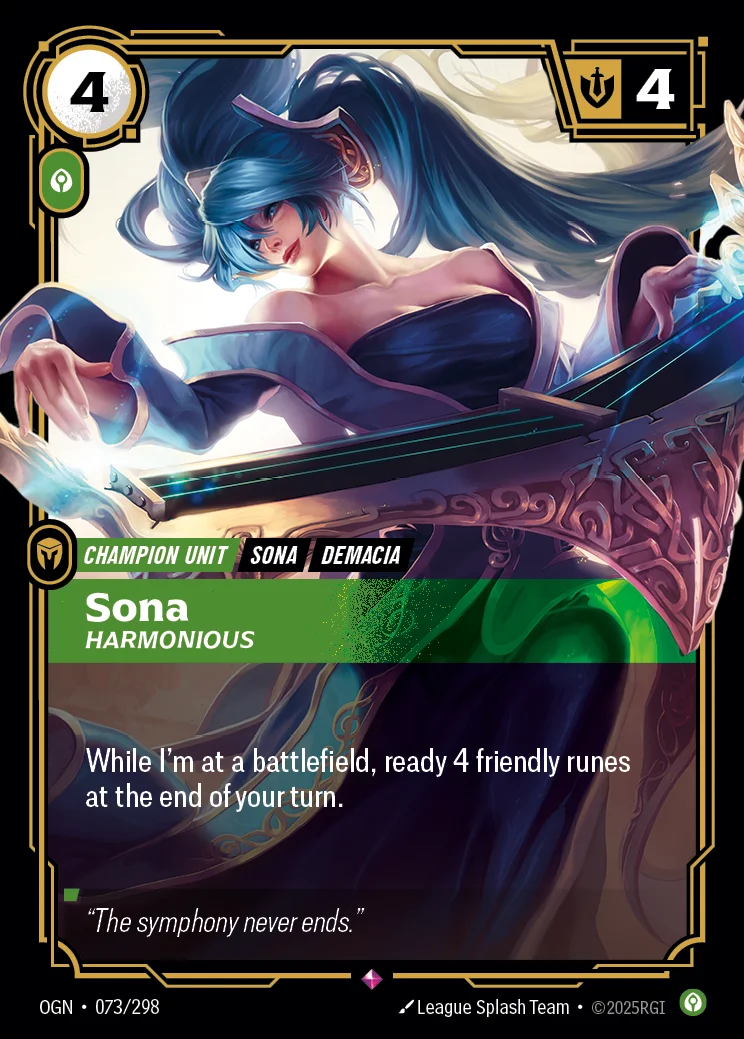
Campeón Unidad
Sona
Harmonious
Energía
Aún no hay texto oficial en Español para esta carta: se muestra en inglés.
Reglas
While I'm at a battlefield, ready 4 friendly runes at the end of your turn.
Texto de ambientación
“The symphony never ends.”
Información de la carta
- Expansión
- Origins OGN
- Número de carta
- OGN-073/298
- Rareza
- Rara
- Tipo
- Campeón Unidad
- Etiqueta de campeón
- Sona
- Etiquetas
- Sona, Demacia
- Poder
- 1
- Artista
- League Splash Team
Nombres en otros idiomas
Legalidad
Soporte en el simulador
Totalmente programada
Todas las habilidades impresas funcionan en el simulador.
Aclaraciones y erratas
›Triggered Abilities
We’ll start with the most significant and contextual rules change in this update. As of our third rules update, triggered abilities have been changed in their structure: rather than a one clause condition and a potentially multi-clause effect, there are now multiple pieces that need to be considered when putting a triggered ability on the chain and finalizing it. The easiest way to think about these is shifting where the effect and condition split into two components of the triggered ability: instead of at the first comma, it now depends on how the triggered ability is templated. Triggered abilities will have one or more of the following four items in sequence:
- A trigger condition
- A conditional statement next to the trigger condition
- A “you may” that appears next to the conditional statement
- A cost within instruction next to the “you may”
We can best see this in the example of Piltover Enforcer, the Vi Legend from Unleashed: “[When you conquer], [if you assigned 3 or more excess damage], [you may] [exhaust me to] ready a unit.” This ability contains all four elements in the sequence.
- A trigger condition: “When you conquer”
- Extra conditional: “If you assigned 3 or more excess damage,”
- A “you may” that appears next to the conditional: “You may,” - this indicates the decision of whether or not to place the ability on the chain
- A cost within instruction next to the “you may”: “Exhaust me to...” - is the cost within instructions that becomes the base cost of the triggered ability.
We can imagine splitting this ability into two sections: the part including this sequence and the part after it:
Before
After
“When you conquer, if you assigned 3 or more
excess damage, you may exhaust me to”“ready a unit.”
The second section only becomes a finalized chain item when the first section is fulfilled by the process of finalization; that being the process by which players make choices, pay costs, and check legality for cards and abilities. When the trigger condition and extra conditional are fulfilled and the player decides to place it on the chain, it will become a pending chain item and be queued for finalization. If its controller chooses a legal target and pays the cost during the subsequent finalization, the second section will become a finalized chain item. All it says on the chain is “Ready a unit,” where the unit is the one chosen during finalization.
Triggered abilities, however, don’t need to contain all of the above elements in order for the sequence to follow these rules, as long as the elements that do appear are where they would be based on our understanding of the above sequence.
Let’s look at a few examples:
Sona, Harmonious reads “At the end of your turn, if I'm at a battlefield, ready up to 4 friendly runes.” “If I’m at a battlefield,” appears where we would expect it to based on the sequence described above, so it is part of the condition and not the effect. The ability can be split into “At the end of your turn, if I’m at a battlefield,” and “ready up to 4 runes.”
Disarming Rake reads “When you play me, you may kill a gear.” The “you may” appears here where we would expect it to based on the sequence above, so it is the choice of whether or not to place the ability on the chain, and not part of the effect itself. The ability can be split into “When you play me, you may” and “kill a gear.”
Ekko, Recurrent reads, “[Deathknell][>] Recycle me to ready your runes.” Deathknell is functionally short for “When I die, …” We can translate this to our sequence as “When I die, recycle me to ready your runes.” “Recycle me to” is a cost within instructions that appears where we would expect it to based on our sequence, so it becomes the base cost of the ability when it is placed on the chain and is not part of the effect. The ability can be split into “When I die, recycle me to” and “ready your runes.”
Any of these elements that appear later in the ability than where you would expect based on the sequence do not function in this way.
Loose Cannon, the Jinx Legend, reads “At the start of your Beginning Phase, draw 1 if you have one or fewer cards in your hand.” The conditional statement “if you have one or fewer cards in your hand,” does not appear where we would expect in the sequence described above, so it is considered part of the effect and not the condition. This ability can be split into “At the start of your Beginning Phase,” and “draw 1 if you have one of fewer cards in your hand.”
Ornn, Blacksmith reads “When you play me or when I hold, look at the top 4 cards of your Main Deck. You may reveal a gear from among them and draw it. Then recycle the rest.” The “you may” here doesn’t appear in the appropriate place to be part of the sequence, so it is not a decision made when the ability triggers and instead is made when ability resolves. This ability can be split into “When you play me or when I hold,” and “look at the top 4 cards of your Main Deck. You may reveal a gear from among them and draw it. Then recycle the rest.”
Insightful Investigator reads “When you play me, choose an opponent. They reveal their hand. You may pay 2 XP to choose a card from their hand. If you do, they discard that card and draw 1.” Here we see the final example, where the ability contains a cost within instructions that does not fall where we would expect it to be for the sequence. This cost within instructions is paid on resolution and not as the base cost of the triggered ability. The ability can be split into “When you play me,” and “Choose an opponent. They reveal their hand. You may pay 2 XP to choose a card from their hand. If you do, they discard that card and draw 1.” The second part of the ability is all one chain item—it resolves it one go, and cannot be reacted to partway through resolution.
One notable effect of this change is that we see a larger difference between two previously similar templates: costs within instructions (“[do X] to [do Y]”) and “if you do” templates. The two templates had some overlap, in that they asked players to perform an action in order to get an effect. The templates, however, were still functionally different before this rules update. Costs don’t care if the game action being performed is replaced, as long as an attempt was made to perform the action.
“If you do” templating is more particular, as seen in cards like Jayce, Man of Progress whose triggered ability begins with, “When you play me, you may kill a friendly gear. If you do, …” Killing the friendly gear in this case is not a cost for the ability, but a game action that a later instruction checks. If the game action is not performed or is replaced, the later instruction will not have its condition fulfilled - the player didn’t “do” it, so “if you do” is not true.
While this was always the case, now there is even more differentiation, as “if you do” templating isn’t a cost within instructions and therefore cannot be the base cost of the triggered ability. Even if resources are instructed to be spent, as in the case of Draven, Vanquisher (RIP), who reads “When I attack or defend, you may pay [C]. If you do, …” those resources are not a cost and are paid on resolution of the ability and not finalization.
›What about triggered abilities with multiple targets, like Sona, Harmonious?
Sigil of the Storm
›ErrataSona, Harmonious
Texto actual
At the end of your turn, if I'm at a battlefield, ready up to 4 friendly runes.
Texto anterior
While I'm at a battlefield, ready 4 friendly runes at the end of your turn.