Spell
Promising Future
Energy
Rules
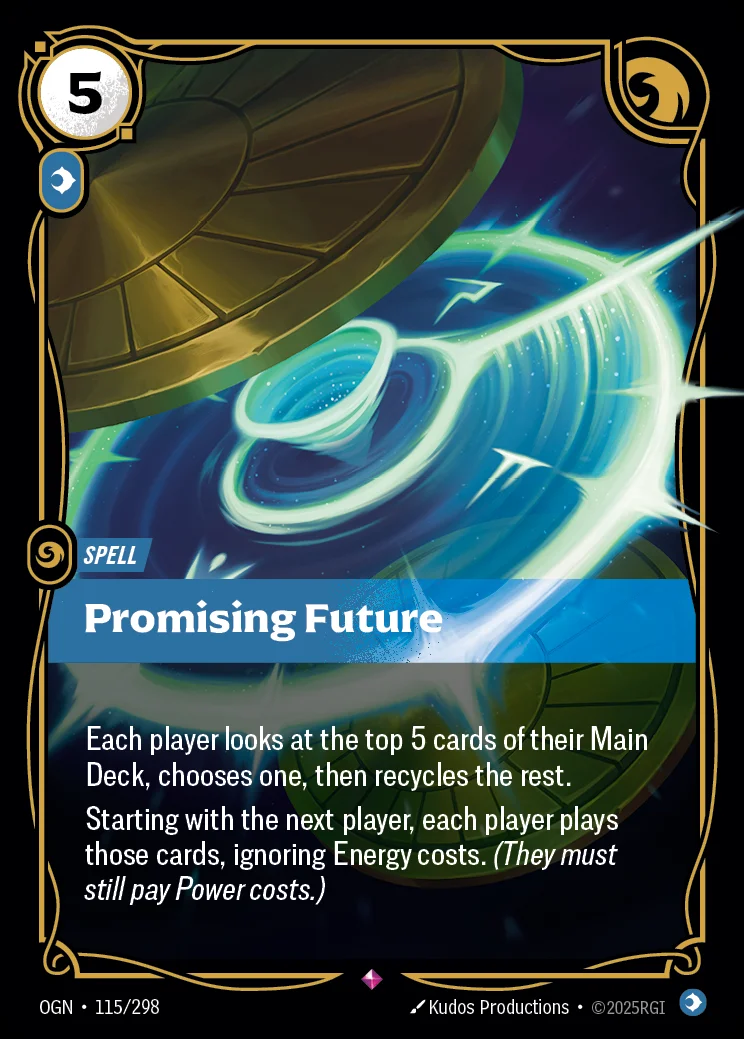
Each player looks at the top 5 cards of their Main Deck, chooses one, then recycles the rest. Starting with the next player, each player plays those cards, ignoring Energy costs. (They must still pay Power costs.)
Card information
- Set
- Origins OGN
- Card number
- OGN-115/298
- Rarity
- Rare
- Type
- Spell
- Power
- 1
- Illustrator
- Kudos Productions
Names in other languages
Legality
Simulator support
Fully scripted
Every printed ability works in the simulator.
Rulings & errata
›Origins cards that instruct players to play cards from their deck, like Promising Future and Blind Fury, received errata to banish those cards before playing them. Will Spiritforged cards with similar abilities receive similar errata?
Yes! This is mostly a bookkeeping thing—banishing the card ensures that the game has a place to put the card until it’s actually played, and a place to send the card back to if it can’t be played for whatever reason. 99% of the time, these cards work the same with or without this errata, but we need to cover those weird corner cases. This impacts 3 Spiritforged cards, plus 1 Origins card that got past us last time.
Rek’Sai, Swarm Queen (revised text)
When I attack, you may reveal the top 2 cards of your Main Deck. You may banish one, then play it. If it is a unit, you may play it here. Recycle the rest.
Void Burrower (revised text)
When you conquer, you may exhaust me to reveal the top 2 cards of your Main Deck. You may banish one, then play it. Recycle the rest.
Void Rush (revised text)
Reveal the top 2 cards of your Main Deck. You may banish one, then play it, reducing its cost by [2]. Draw any you didn't banish.
Reinforce (revised text)
Look at the top 5 cards of your Main Deck. You may banish a unit from among them, then play it, reducing its cost by [5]. Recycle the remaining cards.
Reflexive Triggers on Spiritforged Cards
›What about cards like Blind Fury and Promising Future, which let players look at or reveal cards from the top of a deck, play one, and recycle the rest? If I can’t play that card, where does it go? It sounds like it’s too late for it to be recycled as part of “the rest.”
Hey, you’re pretty sharp! For most cards that let you play something, it’s easy to put the card back where it came from if you can’t play it. The Harrowing would put it back in your trash, Ava Achiever would put it back in your hand, and so on. But when the card came out of a deck, which is both secret and randomized, it’s not so simple.
To provide a clear and easy answer to this question, four cards in set 1 that let you play other cards from decks are receiving errata. They’ll each banish the card before instructing a player to play it. If the card can’t be played for any reason, it just stays banished. This is a small functional change, but it’s one we feel is well worth it to avoid the fuss of getting these cards back into a deck somehow.
Baited Hook
[1][C], [E]: Kill a friendly unit. Look at the top 5 cards of your Main Deck. You may banish a unit from among them that has Might up to 1 more than the killed unit and play it, ignoring its cost. Then recycle the rest.
Blind Fury
[Action] (Play on your turn or in showdowns.) Each opponent reveals the top card of their Main Deck. Choose one and banish it, then play it, ignoring its cost. Then recycle the rest.
Dazzling Aurora
At the end of your turn, reveal cards from the top of your Main Deck until you reveal a unit and banish it. Play it, ignoring its cost, and recycle the rest.
Promising Future
Each player looks at the top 5 cards of their Main Deck, banishes one, then recycles the rest. Starting with the next player, each player plays those cards, ignoring Energy costs. (They must still pay Power costs.)
›So what exactly happens when someone plays Promising Future?
Start with the player whose turn it is—probably Promising Future’s controller. That player looks at their top 5 cards, banishes one of them, and recycles the other 4. Then each other player in turn order repeats this process. Each player can see which cards the players before them have chosen. Then, starting with the next player in turn order this time, those players put the cards they chose onto the chain as pending items, with the player whose turn it is putting their item on the chain last.
Then Promising Future finishes resolving, and the players finish adding their pending items to the chain in the same order they were put there, ignoring Energy costs but still paying Power costs. They must pay mandatory additional costs (like the cost of Cruel Patron), and may choose to pay optional additional costs (like Accelerate).
Each card that’s a unit or gear resolves immediately, which may cause other things (such as play effects) to be added to the top of the chain as pending items. Any cards that can’t be played for any reason remain banished.
Once this process is done, any units or gear that were successfully played this way will be on the board, while spells chosen this way will all be on the chain in the same order they were put onto it. (This may result in spells that don’t have Action or Reaction being on the chain above other items, which is usually not possible. That’s fine.) Then, resolve the chain as normal.
›So if Promising Future resolves and one or more players choose to banish Nocturne from the cards they looked at, what happens?
As you go around in turn order and each player looks at their top 5, they can choose to banish one or more Nocturnes before they banish a card with Promising Future. Any such Nocturnes will go on the chain as pending items before whatever that player chooses with Promising Future. They’ll remain pending through the whole process of resolving Promising Future, then at the appropriate point they’ll be fully placed on the chain and (because they’re units) will resolve immediately.
›ErrataPromising Future
Current wording
Each player looks at the top 5 cards of their Main Deck, banishes one of them, then recycles the rest. Starting with the next player, each player plays those cards, ignoring Energy costs. (They must still pay Power costs.)
Previous wording
Each player looks at the top 5 cards of their Main Deck, chooses one, then recycles the rest. Starting with the next player, each player plays those cards, ignoring Energy costs. (They must still pay Power costs.)