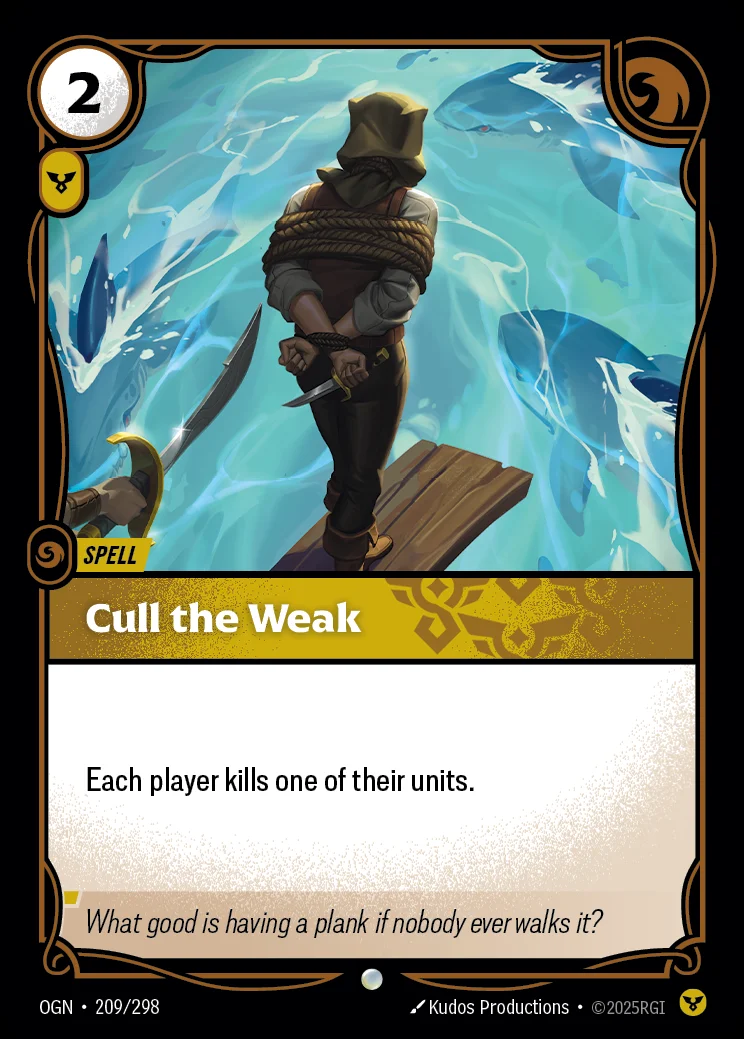
Spell
Cull the Weak
Energy
Rules
Each player kills one of their units.
Flavor text
“What good is having a plank if nobody ever walks it?”
Card information
- Set
- Origins OGN
- Card number
- OGN-209/298
- Rarity
- Common
- Type
- Spell
- Power
- 1
- Illustrator
- Kudos Productions
Names in other languages
Legality
Simulator support
Fully scripted
Every printed ability works in the simulator.
Rulings & errata
›What does it mean to “kill a unit with a spell?” It seems like Hidden Blade counts, but what about a spell that deals damage? A spell that causes a unit to deal damage? A spell that causes a unit to die in some other way, like Stupefy on a unit that has 1 more Might than it has damage currently marked on it?
This is unclear under existing rules, so the updated rules will clarify. “When you kill a unit with a spell” triggers immediately after a spell you control resolves if either of the following is true:
1. That spell instructs you to kill a unit during its resolution, and that unit is put into the trash this way.
2. A spell instructs you to deal damage to a unit during its resolution, and that unit is put into the trash during the cleanup immediately following that spell’s resolution.
This includes “direct kill” spells you control like Hidden Blade. It also includes damage spells like Void Seeker, provided they mark lethal damage on the unit that immediately causes it to die. In all cases, the unit has to actually die—if that death is replaced by a card like Unlicensed Armory, then you didn’t kill a unit with a spell.
Notably, the following do not count as you killing a unit with a spell:
- You are instructed to kill a unit by a spell another player controls, even if the spell instructs you to kill the unit (e.g., another player’s Cull the Weak).
- Another player is instructed to kill a unit by a spell you control (e.g., your Cull the Weak, if you don’t kill any of your own units with it).
- You play a spell like Challenge that causes a unit to deal lethal damage to another unit.
- You use a spell to mark damage on a unit and the unit dies later in the turn, even if that damage later became lethal damage for any reason.
- You use a spell to directly or indirectly lower the Might of a unit, causing damage it’s already taken to become lethal damage. For example:
- ○ You use a spell like Stupefy to lower the Might of a unit that has already taken damage, causing that damage to become lethal damage.
- You use a spell like Charm to move a unit with damage on it away from Trifarian War Camp, indirectly lowering its Might and causing that damage to become lethal damage.
- You use a spell like Rebuke to return Lee Sin, Centered to its owner’s hand, indirectly lowering the Might of a buffed unit at the same battlefield that has damage on it, causing that damage to become lethal damage.
- You do anything else with a spell that causes a unit to die in any other way than the two methods listed above, or at any time other than during or immediately after the spell’s resolution.
- You do any of the above, but the unit doesn’t actually die.
›Appendix: Targeting
This section features a full breakdown of the rules for what constitutes a target. As we said above, most things that are affected by a spell or ability are targets.
An object or player mentioned in a spell or ability is a target if all of the following are true:
- something publicly visible to all players;
- that you and you alone choose;
- that isn’t part of a targeting restriction, cost, trigger condition, replacement effect, or an action that “must” be taken.
Breaking that down a bit:
1) “Something publicly visible to all players” means a player, or a game object that’s in a zone whose information level is Public.
- For example, a unit on the board, a spell on the chain, a card in the trash, or a player can all be targets.
- A card in your hand cannot be a target, because it’s not in a Public zone. If you’re required to choose a card in your hand, you’ll do it as the spell or ability resolves.
- A facedown card at a battlefield can be a target, because while the card’s face is Private information, its presence as a facedown card in that zone is Public.
- “You may play a unit from your hand, ignoring its costs” doesn’t have a target; “You may play a unit from your trash, ignoring its costs” targets a unit in your trash.
2) “That you and you alone choose” means two things:
- First, it excludes choices that are made in whole or in part by other players, like the units killed by Cull the Weak. Cull the Weak doesn’t have any targets, because you’re instructed to kill a unit as part of an instruction for all players to choose and kill a unit.
- Second, it excludes anything that is not a choice. Some examples: something that affects “all” objects that meet some set of criteria (no choice to be made because all of them are affected); a reference to “[something’s] controller” (no choice to be made because it only has one controller); or a reference to “your legend” (because you can only have one legend).
- This exception does not apply to things that are currently the only legal option for what would otherwise be a choice; for example, a spell that says “Kill an enemy unit” always targets that enemy unit, even if it’s currently the only enemy unit on the board.
3) “that isn’t part of a targeting restriction, cost, trigger condition, replacement effect, or an action that ‘must’ be taken” means that an object isn’t a target just because it’s mentioned in text, it has to be acted upon directly or instructed to act by the spell or ability’s instructions.
- “Targeting restriction” excludes objects that are mentioned in order to identify other targets. A spell that refers to a “unit at a battlefield” targets the unit, but not the battlefield.
- “Cost” excludes anything that’s listed before the colon in an activated ability or as part of an additional cost. Cruel Patron’s additional cost and Malzahar’s activated ability don’t have any targets. They are chosen as the card or ability is placed on the chain, but that’s because they’re costs, not because they’re targets.
- “Trigger condition” excludes anything that’s identified as part of a triggered ability’s conditions; “When an enemy unit attacks, give it -1 Might this turn.” doesn’t have any targets.
- “Replacement effect” excludes anything that is part of the condition or the effect of a replacement effect. A hypothetical card that said “The next time a friendly unit would die, you may kill another friendly unit instead” wouldn’t target anything; it would apply the next time any friendly unit died, and you could choose to kill any other friendly unit without it being a target either. If it instead said “Choose a friendly unit. The next time it would die…”, then it would target a specific unit, and would look for the next time that unit died.
- Actions that “must” be taken are a new category to handle cards like Sigil of the Storm. It excludes only units that use this wording, and its purpose is to make sure that we can make cards that require something to happen and make sure it actually does.