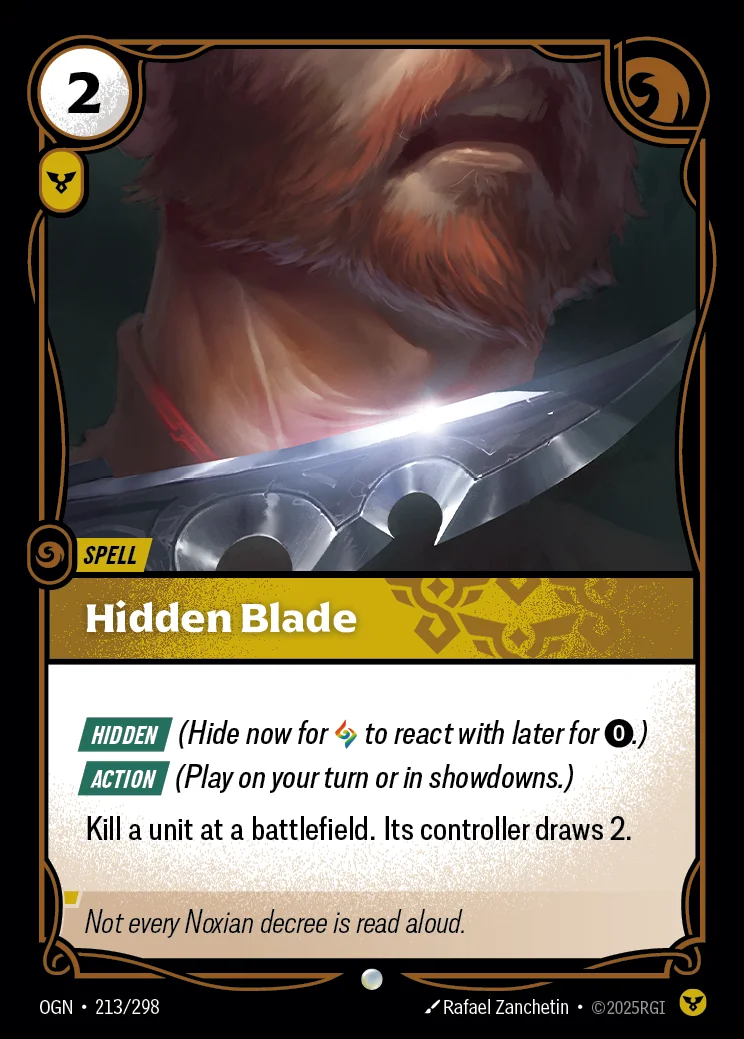
Spell
Hidden Blade
Energy
Rules
Hidden (Hide now for to react with later for .)
Action (Play on your turn or in showdowns.)
Kill a unit at a battlefield. Its controller draws 2.
Flavor text
“Not every Noxian decree is read aloud.”
Card information
- Set
- Origins OGN
- Card number
- OGN-213/298
- Rarity
- Common
- Type
- Spell
- Power
- 1
- Illustrator
- Rafael Zanchetin
Names in other languages
Keywords explained
HiddenCR 811Prerequisite keyword (Hide)
It is functionally short for "While this card is in your hand or in your Champion Zone on your turn during an Open State, you may pay to hide this facedown at a battlefield you control that doesn't already have a facedown card hidden there for as long as you control that battlefield. Beginning on the next turn, this gains [Reaction] and you may play this, ignoring its base cost."
ActionCR 806Permissive
"This can be played during showdowns on any player's turn." 806.1.c.2 (abilities): "This can be activated during showdowns on any player's turn."
Functional text from the Core Rules
Legality
Simulator support
Fully scripted
Every printed ability works in the simulator.
Rulings & errata
›What happens when my opponent plays Hidden Blade targeting my Akali, Deadly Weapon in reaction to her move trigger? Will it still deal damage to the chosen unit?
It will.
Akali is another case where her ability refers to information implicit to its own trigger condition, similar to Iascylla. Akali’s “battlefield I moved to or from” doesn’t require her to be on the board in order for us to be able to identify it, nor does it reference information about her current state. Even if she leaves the board, that information was checked when her ability triggered, and it is still available to us on resolution.
Relevant Rules: 359.3.f.3.
Source: Riftbound: Vendetta Rules FAQ and Clarifications (newest FAQ found)
›If I play Ride the Wind targeting my unit at Vilemaw’s Lair and attempt to move them to base, what happens?
They will be readied.
This is a rules quirk that players and judges identified as a result of a small additional rule added in the Vendetta rules update. We’re going to give some clarity to this that will resolve this issue, but if you don’t understand the conversation or why it is necessary, don’t worry. This isn’t an actual change to how we’ve been interpreting and ruling cards, but smoothing out a bug.
In short, the linked instructions rules are too expansive currently on what qualifies as an “ignored” instruction. To clarify this definition: an ignored instruction is one that wasn’t performed as part of the execution of a spell or ability’s instructions because it mistargeted (i.e. because the targeted object wasn’t a legal target on resolution). This is a case where, for example, you play Hidden Blade choosing an enemy unit and they play Star-Crossed in reaction, returning their unit to hand. When Hidden Blade resolves, the unit isn’t on the board, so we ignore the “Its controller draws 2.” instruction. Alternatively, if Hidden Blade is given the Repeat keyword by the Academy and both executions target the same unit, this is the reason why the unit’s controller doesn’t draw 4 cards.
An instruction is not ignored if an ability, effect, or circumstance of the game prevents it from occurring. This could take the form of a replacement effect that replaces the event of the instruction with something else, it could take the form of an ability like Vilemaw’s Lair that says “Units can’t move from here to base.” or it could take the form of a game action like Buff or Ready being performed on a unit that already has the appropriate state. It could even take the form of a unit, gear, or spell no longer being in an appropriate zone as long as the instruction doesn’t target those objects. The instruction in these cases isn’t ignored, but instead negated. A negated instruction has its effects skipped, replaced, or prevented. A negated instruction will not cause any linked instructions to be ignored unless those instructions refer specifically to the action being performed.
Some examples:
- If a unit at a battlefield says “I can’t be killed.” and a player plays Hidden Blade choosing that unit, the unit’s controller will still draw 2 on resolution of Hidden Blade. (The instruction was negated and not ignored, so the linked instruction will still execute.)
- If a unit at a battlefield is chosen by Hidden Blade and in reaction its controller plays Flash moving it to base, that unit’s controller will not draw 2 on resolution of Hidden Blade. (The instruction was ignored, so any linked instructions will be ignored.)
- If a unit at a battlefield is chosen by Hidden Blade and in reaction its controller plays Zhonya’s Hourglass, that unit’s controller will draw 2 on resolution of Hidden Blade. (The unit is on the board and can have its information checked, and the instruction was negated and not ignored.)
- If a unit at a battlefield has been affected by Smite previously this turn and it is chosen by Hidden Blade, that unit’s controller will not draw 2 on resolution of Hidden Blade. (Although the instruction is executed, the unit is not on the board to have its information checked. Additionally, the unit was moved to a non-board zone by an effect other than Hidden Blade and thus no longer has a controller that Hidden Blade can reference.)
Source: Riftbound: Vendetta Rules FAQ and Clarifications (newest FAQ found)
›When I replace a unit’s death with a card like Unlicensed Armory, does damage on the unit stay? If the unit died to lethal damage, doesn’t it just die again?
The intent behind these four cards is to save your unit from dying, whether it died due to direct kill like Hidden Blade or due to lethal damage. To better communicate this, these cards will receive updated wordings. Two of them, Highlander (from the Proving Grounds boxed set) and Unlicensed Armory, have straightforward fixes, adding “heal” and listing “exhaust” and “recall” as separate actions.
Highlander
[Reaction] (Play any time, even before spells and abilities resolve.)
Choose a friendly unit. The next time it dies this turn, heal it, exhaust it, and recall it instead. (Send it to base. This isn't a move.)
Unlicensed Armory
Discard 1, [E]: Choose a friendly unit. The next time it would die this turn, you may pay [C] to heal it, exhaust it, and recall it instead. (Send it to base. This isn't a move.)
Zhonya’s Hourglass also has a slightly updated wording making it clearer that its ability applies any time a friendly unit dies, not just on the turn you play it.
Zhonya’s Hourglass
[Hidden] (Hide now for [A] to react with later for [0].) If a friendly unit would die, kill this instead. Heal that unit, exhaust it, and recall it. (Send it to base. This isn't a move.)
The Boss was mistakenly worded like a triggered ability. It’s receiving updated wording to make it clear that its ability is a replacement effect.
The Boss (revised text)
If a buffed unit you control would die, you may pay [C], exhaust me, and spend its buff to heal it, exhaust it, and recall it instead. (Send it to base. This isn't a move.) When you conquer, ready me.
›If a unit would be killed by Hidden Blade, but one of these cards replaces that unit’s death, does the unit’s controller still draw 2?
Yes. Hidden Blade attempts to kill a unit, then says that “its controller” draws 2. Even if the unit doesn’t die, it’s still on the board and information about its controller is still available, so that player draws 2. This is different from Baited Hook, which requests information about “the killed unit,” and can’t find any information if no unit was actually killed.
Timing of Healing Damage at End of Combat
›What does it mean to “kill a unit with a spell?” It seems like Hidden Blade counts, but what about a spell that deals damage? A spell that causes a unit to deal damage? A spell that causes a unit to die in some other way, like Stupefy on a unit that has 1 more Might than it has damage currently marked on it?
This is unclear under existing rules, so the updated rules will clarify. “When you kill a unit with a spell” triggers immediately after a spell you control resolves if either of the following is true:
1. That spell instructs you to kill a unit during its resolution, and that unit is put into the trash this way.
2. A spell instructs you to deal damage to a unit during its resolution, and that unit is put into the trash during the cleanup immediately following that spell’s resolution.
This includes “direct kill” spells you control like Hidden Blade. It also includes damage spells like Void Seeker, provided they mark lethal damage on the unit that immediately causes it to die. In all cases, the unit has to actually die—if that death is replaced by a card like Unlicensed Armory, then you didn’t kill a unit with a spell.
Notably, the following do not count as you killing a unit with a spell:
- You are instructed to kill a unit by a spell another player controls, even if the spell instructs you to kill the unit (e.g., another player’s Cull the Weak).
- Another player is instructed to kill a unit by a spell you control (e.g., your Cull the Weak, if you don’t kill any of your own units with it).
- You play a spell like Challenge that causes a unit to deal lethal damage to another unit.
- You use a spell to mark damage on a unit and the unit dies later in the turn, even if that damage later became lethal damage for any reason.
- You use a spell to directly or indirectly lower the Might of a unit, causing damage it’s already taken to become lethal damage. For example:
- ○ You use a spell like Stupefy to lower the Might of a unit that has already taken damage, causing that damage to become lethal damage.
- You use a spell like Charm to move a unit with damage on it away from Trifarian War Camp, indirectly lowering its Might and causing that damage to become lethal damage.
- You use a spell like Rebuke to return Lee Sin, Centered to its owner’s hand, indirectly lowering the Might of a buffed unit at the same battlefield that has damage on it, causing that damage to become lethal damage.
- You do anything else with a spell that causes a unit to die in any other way than the two methods listed above, or at any time other than during or immediately after the spell’s resolution.
- You do any of the above, but the unit doesn’t actually die.
›Can Immortal Phoenix return if it is the unit that was killed? Or if it and other units were killed at the same time? For example, can I Hidden Blade on my own Phoenix and immediately replay it?
Yes. Triggers like this are evaluated immediately after the event that takes place, at which point Phoenix is in the trash.
Void Gate