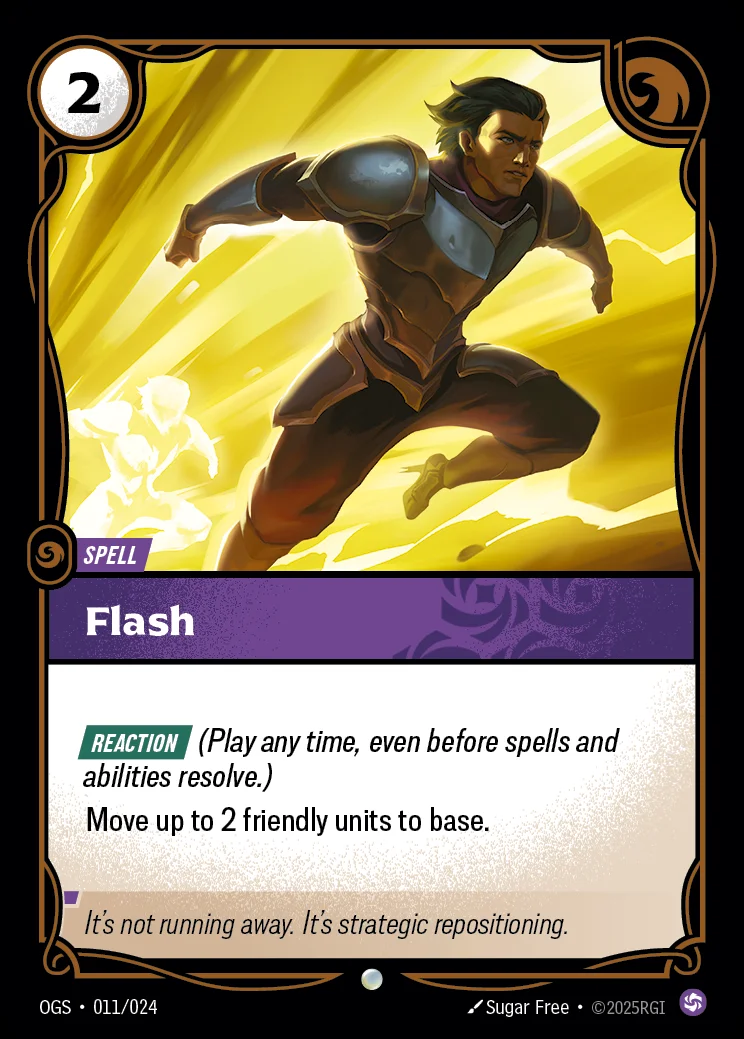
Spell
Flash
Energy
Rules
Reaction (Play any time, even before spells and abilities resolve.)
Move up to 2 friendly units to base.
Flavor text
“It's not running away. It's strategic positioning.”
Card information
- Set
- Origins: Proving Grounds OGS
- Card number
- OGS-011/024
- Rarity
- Common
- Type
- Spell
- Illustrator
- Sugar Free
Names in other languages
Keywords explained
ReactionCR 813Permissive
"This can be played during Closed States on any player's turn." 813.1.c.2 (abilities): "This can be activated during Closed States on any player's turn."
Functional text from the Core Rules
Legality
Simulator support
Fully scripted
Every printed ability works in the simulator.
Rulings & errata
›What happens if my opponent plays Flash on their Akali, Silent that’s currently in combat after I play Star-Crossed targeting her?
Akali will be unaffected by Star Crossed as it resolves.
Akali, Silent is what the rules refer to as “untargetable” for enemy spells and abilities when she isn’t in combat; meaning she is not a legal target for them. Enemy spells and abilities being played when she’s untargetable can’t choose her. If she becomes untargetable after she’s already been chosen by an effect and retains it as that effect begins to resolve, it will “mistarget” her. She will be unaffected by any of the spell or ability’s instructions. If an instruction chooses only her, that instruction will be ignored.
Relevant Rules: 757.1., 758., 758.1.
Source: Riftbound: Vendetta Rules FAQ and Clarifications (newest FAQ found)
›If I play Ride the Wind targeting my unit at Vilemaw’s Lair and attempt to move them to base, what happens?
They will be readied.
This is a rules quirk that players and judges identified as a result of a small additional rule added in the Vendetta rules update. We’re going to give some clarity to this that will resolve this issue, but if you don’t understand the conversation or why it is necessary, don’t worry. This isn’t an actual change to how we’ve been interpreting and ruling cards, but smoothing out a bug.
In short, the linked instructions rules are too expansive currently on what qualifies as an “ignored” instruction. To clarify this definition: an ignored instruction is one that wasn’t performed as part of the execution of a spell or ability’s instructions because it mistargeted (i.e. because the targeted object wasn’t a legal target on resolution). This is a case where, for example, you play Hidden Blade choosing an enemy unit and they play Star-Crossed in reaction, returning their unit to hand. When Hidden Blade resolves, the unit isn’t on the board, so we ignore the “Its controller draws 2.” instruction. Alternatively, if Hidden Blade is given the Repeat keyword by the Academy and both executions target the same unit, this is the reason why the unit’s controller doesn’t draw 4 cards.
An instruction is not ignored if an ability, effect, or circumstance of the game prevents it from occurring. This could take the form of a replacement effect that replaces the event of the instruction with something else, it could take the form of an ability like Vilemaw’s Lair that says “Units can’t move from here to base.” or it could take the form of a game action like Buff or Ready being performed on a unit that already has the appropriate state. It could even take the form of a unit, gear, or spell no longer being in an appropriate zone as long as the instruction doesn’t target those objects. The instruction in these cases isn’t ignored, but instead negated. A negated instruction has its effects skipped, replaced, or prevented. A negated instruction will not cause any linked instructions to be ignored unless those instructions refer specifically to the action being performed.
Some examples:
- If a unit at a battlefield says “I can’t be killed.” and a player plays Hidden Blade choosing that unit, the unit’s controller will still draw 2 on resolution of Hidden Blade. (The instruction was negated and not ignored, so the linked instruction will still execute.)
- If a unit at a battlefield is chosen by Hidden Blade and in reaction its controller plays Flash moving it to base, that unit’s controller will not draw 2 on resolution of Hidden Blade. (The instruction was ignored, so any linked instructions will be ignored.)
- If a unit at a battlefield is chosen by Hidden Blade and in reaction its controller plays Zhonya’s Hourglass, that unit’s controller will draw 2 on resolution of Hidden Blade. (The unit is on the board and can have its information checked, and the instruction was negated and not ignored.)
- If a unit at a battlefield has been affected by Smite previously this turn and it is chosen by Hidden Blade, that unit’s controller will not draw 2 on resolution of Hidden Blade. (Although the instruction is executed, the unit is not on the board to have its information checked. Additionally, the unit was moved to a non-board zone by an effect other than Hidden Blade and thus no longer has a controller that Hidden Blade can reference.)
Source: Riftbound: Vendetta Rules FAQ and Clarifications (newest FAQ found)
›My opponent plays Elder Dragon and targets my two units at the two battlefields, as well as one of my units in base. If I play Flash in reaction, moving the two units at battlefields to base, will they be dealt damage?
They will not.
Elder Dragon’s play effect has a number of targeting restrictions equal to the number of locations on the board. Its controller chooses up to one enemy unit at each of those locations to target with the ability and each of those units must follow their respective targeting restriction. It is the equivalent to saying “Deal 1 to up to one enemy unit at battlefield A. Deal 1 to up to one enemy unit at battlefield B. Deal 1 to up to one enemy unit in your base. Deal 1 to up to one enemy unit in Opponent A’s Base. …” Each of those targeting restrictions is fulfilled separately for each unit targeted.
If you play Flash in reaction to the play effect of Elder Dragon, any units that are moved to a location other than the one where they were targeted will no longer fulfill the targeting restriction of the Elder Dragon play effect and will be unaffected by the ability as it resolves.
›I play Alpha Strike targeting my Master Yi, Unstoppable and splitting 12 damage among three of the four enemy units at battlefields. If my opponent plays Flash in reaction to my Alpha Strike, moving two of the targeted units to base, can they then play Repulse and counter my Alpha Strike?
No, they cannot play Repulse targeting your Alpha Strike. (Except if both of the other chosen units have changed to a non-board zone, such as via the effect of something like Grim Apothecary’s play effect, Heedless Resurrection’s additional cost, or the instructions of Thrill of the Hunt.)
A spell that targets a game object creates a targeting relationship between it and the targeted game object. As long as that targeted game object remains on the board, that relationship is maintained even if the target no longer fulfills the targeting restrictions of the spell. Even if the units in this example aren’t at a battlefield anymore, they are still being chosen by Alpha Strike. We know this is true because the spell remembers that it is targeting those units if they happen to fulfill its targeting restrictions again per rule 359.3.e.3. The only exception to this principle is if the units change to a non-board zone—in such a case, they are no longer the same game object and any relationship between them and the spell that targets them is severed. Even if they returned to the same battlefield, they won’t be legal targets and the spell won’t be choosing them.
359.3.e.3.If a target ceases to meet the targeting requirements while the spell is on the chain, then meets them again, it's a legal target.
It can help to visualize Alpha Strike’s targets with a colored arrow pointing from Alpha Strike to those units. Even if the units move to base and are no longer legal targets, they are still being chosen by Alpha Strike; we can imagine that the arrow is greyed out, but still present. Meanwhile, if they moved to a non-board zone the arrow would disappear entirely, since the game object it is connected to no longer exists. Repulse cares about the number of those arrows that point to friendly units, not the color of the arrows.