Unit
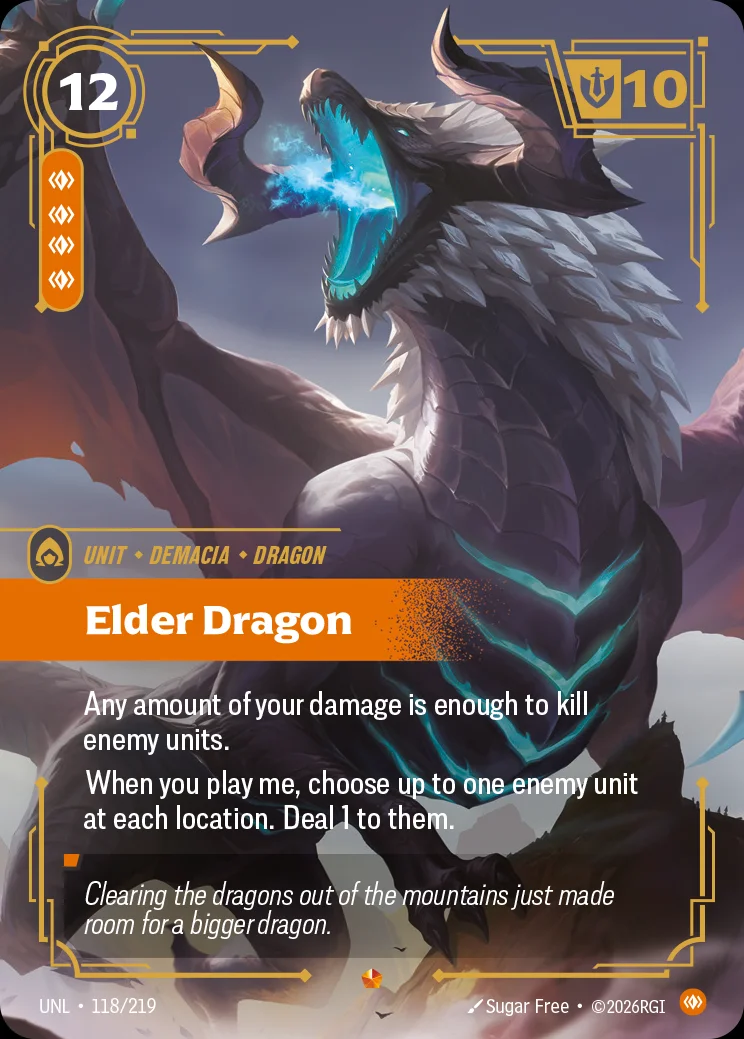
Elder Dragon
Energy
Rules
Any amount of your damage is enough to kill enemy units.
When you play me, choose up to one enemy unit at each location. Deal 1 to them.
Flavor text
“Clearing the dragons out of the mountain just made room for a bigger dragon.”
Card information
- Set
- Unleashed UNL
- Card number
- UNL-118/219
- Rarity
- Epic
- Type
- Unit
- Tags
- Dragon, Demacia
- Power
- 4
- Illustrator
- Sugar Free
Names in other languages
Legality
Simulator support
Fully scripted
Every printed ability works in the simulator.
Rulings & errata
›What happens when I play Temporal Breach targeting my Elder Dragon in base and pay [A][A] for Dragon Roost while playing Elder Dragon? Will it be played to base or to Dragon Roost?
You can choose which of those two locations you want to play it to.
In general, there are not many cases where we have this kind of competing instruction: one effect that tells you to play a unit to one location, and one that tells you to play it to another. That being said, when they do arise with contradictory requirements, the precedent from other areas of the rules is that the player chooses one of those requirements and ignores all others.
Note that this only applies to mandatory positive requirements, ones that specify a location or method without also preventing the action from being performed to other locations or with other methods and that aren’t optional. For example, an effect like Perched Grimwyrm’s passive ability is a restriction on playing that unit to any location other than a battlefield you’ve conquered this turn. Rockfall Path’s passive ability is a restriction on playing units to Rockfall Path. If you’ve conquered only Rockfall Path this turn, you can’t play Perched Grimwyrm at all, because those two restrictions are contradictory.
In this case, the contradictory requirements don’t directly prohibit the playing of these units to other locations, so we can choose one of the contradictory requirements and ignore the rest.
Source: Riftbound: Vendetta Rules FAQ and Clarifications (newest FAQ found)
›What happens when I play Hextech Ray on an Elder Dragon while Imperial Decree’s delayed trigger is active and I have an Immortal Phoenix in the Trash? Can I play Immortal Phoenix from the Trash?
You can.
Per the current rules, there is nothing that would stop Imperial Decree’s delayed trigger from triggering Immortal Phoenix. It is a triggered ability generated by a spell; it is attributed a kill action, and thus the spell that generated it will also be attributed the same kill action. The owner of Imperial Decree is the controller of the delayed triggered ability; the player responsible for the kill action is the one who controls the ability; and that same player is the owner of Immortal Phoenix in the Trash. Thus all three conditions for Immortal Phoenix triggering are complete, and it will trigger.
Source: Riftbound: Vendetta Rules FAQ and Clarifications (newest FAQ found)
›Lethal Damage Modification
Elder Dragon’s passive ability reads, “Any amount of your damage is enough to kill enemy units.” This functions to change the definition of lethal damage for those units that have damage marked by you on them. In order to break that down in a technical way, we’ll have to define a few terms.
Lethal damage is an amount of damage such that a unit with it marked will die in a cleanup. This value is defined as being a non-zero amount greater than or equal to a unit’s Might by default. However, some effects may alter it. Any reference to lethal damage, including in the cleanup tasks in rule 323.5. and when assigning Combat damage in rule 460.2.c.3., will be altered in this way. Damage is marked on a unit by a player when a deal action that player is responsible for damages that unit. Damage marked by players is “their damage.”
The combination of these two concepts codifies how Elder Dragon functions. This means Elder Dragon can check damage marked on units by its controller before it enters the board, and that players need only assign one damage to units during the Combat Damage step while they control Elder Dragon.
323.5.3b. All Units that have non-zero Damage marked on them equalling or exceeding their Might are killed and placed in their owners' Trash.
460.2.c.3.Units must have lethal damage assigned to them in full before damage is assigned to a different Unit.
›If I play Counter Strike in response to my opponent’s Elder Dragon’s play effect, will the chosen unit still die?
No, the unit protected by Counter Strike will not die.
Elder Dragon’s passive ability changes the definition for what is considered lethal damage for a unit, as long as that unit has damage marked by Elder Dragon’s controller on it. However, this doesn’t change the actual amount of damage being dealt. Elder Dragon deals 1 damage to up to one unit at each location—if one of those units has a prevent effect applied to it, that prevent effect will replace as much of that damage as it can. In the case of Counter Strike, it will replace all of the damage. If the damage is entirely prevented, it is never dealt per rule 437.2.a., and thus there is no opportunity for the passive ability of Elder Dragon to apply to that unit.
437.2.a.The damage being dealt as a result of Preventing can never be less than 0, but can be 0. This is equivalent to not dealing damage.
›My opponent plays Elder Dragon and targets my two units at the two battlefields, as well as one of my units in base. If I play Flash in reaction, moving the two units at battlefields to base, will they be dealt damage?
They will not.
Elder Dragon’s play effect has a number of targeting restrictions equal to the number of locations on the board. Its controller chooses up to one enemy unit at each of those locations to target with the ability and each of those units must follow their respective targeting restriction. It is the equivalent to saying “Deal 1 to up to one enemy unit at battlefield A. Deal 1 to up to one enemy unit at battlefield B. Deal 1 to up to one enemy unit in your base. Deal 1 to up to one enemy unit in Opponent A’s Base. …” Each of those targeting restrictions is fulfilled separately for each unit targeted.
If you play Flash in reaction to the play effect of Elder Dragon, any units that are moved to a location other than the one where they were targeted will no longer fulfill the targeting restriction of the Elder Dragon play effect and will be unaffected by the ability as it resolves.